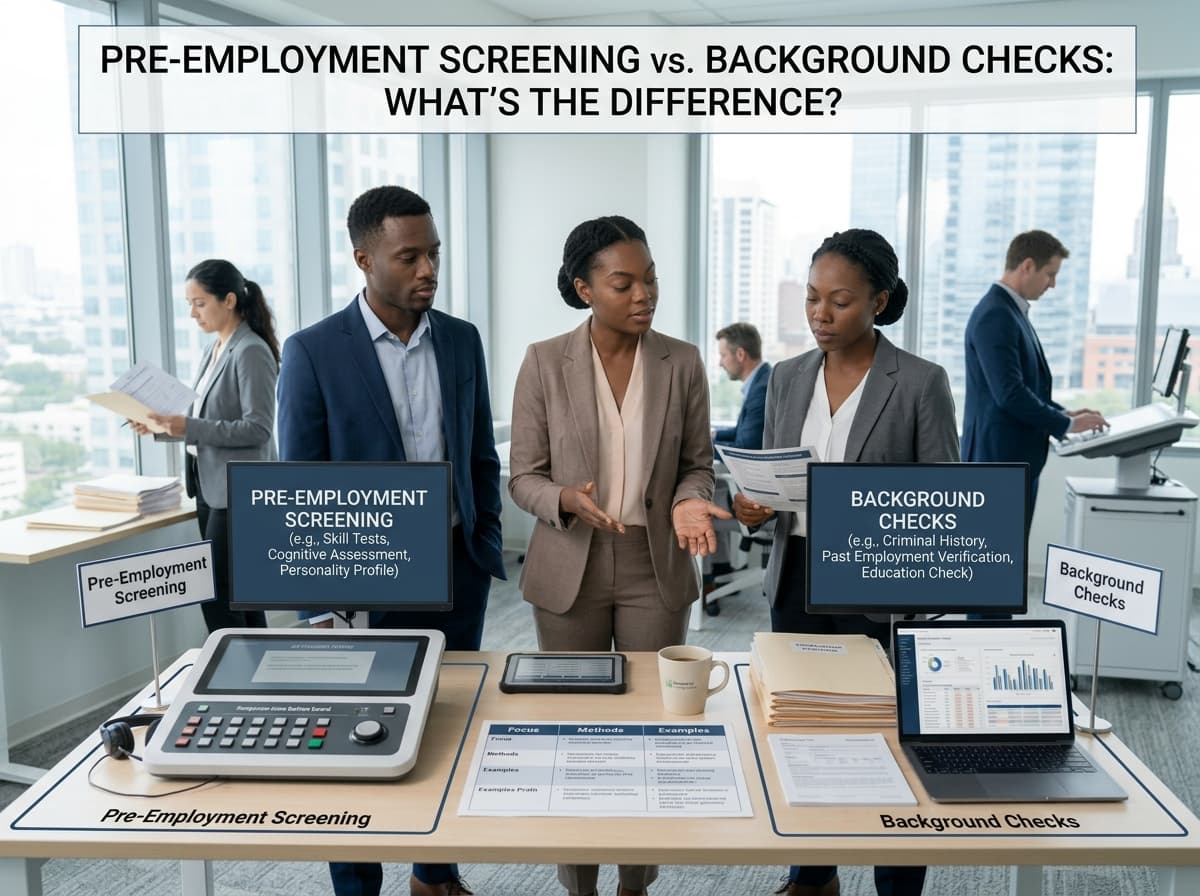
When hiring, HR professionals and operations managers often use pre-employment screening and background checks as if they mean the same thing. While both are part of the recruitment process and help employers assess candidates before onboarding, they serve different purposes.
Pre-employment screening is a broader process that looks at a candidate's overall suitability for a role. Background checks focus on verifying specific information through official records and other reliable sources. Understanding the difference matters because using one in place of the other can leave gaps in your hiring process and create unnecessary compliance risks.
In this article, we'll explain what pre-employment screening and background checks involve, how they differ, and why using both can give employers a more complete view of each candidate before making a hiring decision.
What is Pre-Employment Screening?
Pre-employment screening is the broader process employers use to assess whether a candidate has the skills, experience, alignment, health, and integrity required for a specific role.
It can cover the entire recruitment process, from the initial application through to the point before onboarding. This may include:
Cognitive and Technical Skill Assessments: Coding tests, writing samples, or situational judgment exercises.
Structured Behavioral Interviews: Assessing communication, soft skills, and cultural fit.
Professional Reference Checks: Gathering feedback from former supervisors and colleagues.
Physical or Occupational Screenings: Drug testing or role-specific physical assessments, where legally permitted.
Background Checks: Verifying factual information about the candidate.
In simple terms, pre-employment screening asks: Is this person qualified, capable, and a good fit for the organisation?
What is a Background Check?
A background check is a focused, record-based process used to verify the factual information a candidate provides during recruitment.
Unlike interviews or reference checks, which can involve personal judgment, background checks rely on official records and verified information. Depending on the role, a background check may include:
Employment History Verification: Confirming previous job titles, employment dates, and reasons for leaving.
Identity and SSN Validation: Checking that the candidate’s government-issued details match official records.
Criminal History Checks: Reviewing relevant county, state, and federal court records.
Education and Credential Checks: Verifying degrees, professional credentials, and active licences.
Motor Vehicle Records (MVR) and Credit Checks: Reviewing driving records or financial history for roles where these checks are relevant and legally permitted.
In simple terms, a background check asks: Is this person who they say they are, and is there any documented history that could affect the hiring decision?
Key Differences: Pre-Employment Screening vs. Background Checks
Now that we have defined both terms, the distinction becomes clearer when you compare them side by side.
Feature | Pre-Employment Screening | Background Check |
Primary Goal | Evaluates overall job fit, capabilities, cultural alignment, and potential for success. | Verifies factual claims, confirms identity, and identifies relevant legal, financial, or safety risks. |
Data Type | Combines qualitative feedback, such as interviews and references, with quantitative results from skills assessments. | Relies on objective, verifiable records, databases, and legal documents. |
Funnel Placement | Usually takes place across the early and middle stages of the hiring process, from application through final interviews. | Typically takes place later in the process, often after a conditional offer. |
Legal Framework | Governed by employment laws, EEO guidelines, and non-discrimination requirements. | Subject to specific requirements such as the FCRA, state privacy laws, and applicable Ban-the-Box laws. |
Execution | Usually handled by recruiters, hiring managers, and department leads. | Often conducted through Consumer Reporting Agencies (CRAs) or specialised verification platforms. |
Why Pre-Employment Screening and Background Checks Both Matter
Pre-employment screening and background checks serve different purposes, but they work best when used together. For clarity, let’s break it down into what we like to call “The Dual-Risk Matrix”
The Dual-Risk Matrix
Only Screening (No Background Check) | Only Background Check (No Screening) |
High vulnerability to resume fraud | Unqualified "paper champions" |
Risk of hiring candidates with unverified credentials | Poor cultural alignment |
Potential compliance and verification risks | Team friction and higher turnover |
The matrix highlights the gaps created when one process is used without the other. Screening can give you a broader view of a candidate’s skills, behaviour, and suitability, but without factual verification, you may still miss inaccurate credentials or resume fraud.
That risk is becoming harder to ignore. A Gartner survey of 3,000 job candidates found that 6% admitted to participating in interview fraud, including impersonating another candidate or having someone else interview on their behalf. Gartner also projects that by 2028, one in four candidate profiles worldwide could be fake.
A background check helps address this verification gap, but it has limits of its own. A candidate can have a clean record and verified employment history without having the communication skills, problem-solving ability, or team fit required for the role.
Used together, the two processes give employers a more complete view of the candidate. Background checks verify the facts, while pre-employment screening assesses the broader fit.
How to Structure an Integrated, Compliant Hiring Workflow
Once you understand how pre-employment screening and background checks differ, the next step is bringing them together in one hiring workflow. The goal is not to create two separate processes but to make sure each one happens at the right stage and supports the next.
A well-structured workflow starts by assessing the candidate's skills and suitability, then moves into factual verification once you have identified the right person. This gives your team a clearer basis for making a hiring decision while keeping the required compliance steps in place.
Integrated Hiring Pipeline
Stage | Process | Key Action |
1. Application & Initial Screening | Skills tests and structured interviews | Assess skills, experience, and role fit. |
2. Conditional Offer | Disclosure and written consent | Inform the candidate and obtain the required authorization. |
3. Background Check | Record verification through a CRA | Verify the information relevant to the role. |
4. Final Review & Onboarding | Report review and final decision | Review the findings and proceed with hiring where appropriate. |
Putting the Workflow Into Practice
So, what does this look like in practice? The process can be broken down into four clear phases, starting with the broader assessment of the candidate and moving into verification, review, and the final hiring decision.
Phase 1: Top-of-Funnel Evaluation
Start with the broader screening process. Structured behavioral interviews, job-sample tests, and initial phone screenings can help you assess technical competence, problem-solving ability, communication, and role alignment.
At this stage, the focus is on understanding whether the candidate can do the job and fits what the organisation needs.
Phase 2: Conditional Offer and FCRA Disclosure
Once you have selected your preferred candidate, you can move to a conditional offer. If a background report will be obtained, the required disclosure and authorization should be handled before the check begins.
This includes:
Providing a clear, standalone written disclosure that a background report will be obtained.
Obtaining the candidate's written authorization to conduct the check.
The key here is to treat compliance as part of the workflow rather than something added after the fact.
Phase 3: Factual Record Verification
With the appropriate authorization in place, the background check can focus on the records that are relevant to the position. Working with a qualified Consumer Reporting Agency (CRA) can help your organisation carry out these checks within the applicable requirements.
Depending on the role, this may include:
Employment history: Confirming previous employers, employment dates, and job titles.
Criminal history: Reviewing relevant federal, state, and county court records in line with applicable requirements.
Professional credentials: Verifying required certifications or licences directly with the relevant accrediting bodies.
The point is not to collect every piece of information available. It is to verify the information that is relevant to the hiring decision.
Phase 4: Final Review and Adverse Action
If the report is clear and the candidate meets the other requirements of the role, the organisation can move forward with the final hiring decision.
If the report contains information that may affect the decision, the employer must follow the applicable adverse action process. Under the FCRA, this generally involves:
Sending a Pre-Adverse Action Notice with a copy of the background report and a summary of the candidate's FCRA rights.
Giving the candidate an opportunity to review the information and dispute any inaccuracies before a final decision is made.
If the employer ultimately decides not to hire based on the report, sending a Final Adverse Action Notice.
The exact requirements can vary based on the circumstances and applicable state or local laws, so your process should be reviewed for the jurisdictions in which you hire.
The result is a hiring workflow where screening and verification work together. You assess the candidate first, verify the relevant facts at the appropriate stage, and give the candidate the required opportunity to respond before making a final decision.
Elevate Your Workforce Verification Framework
Pre-employment screening and background checks serve different purposes, but both play an important role in making informed hiring decisions. In this article, we clarified how screening helps you assess a candidate's skills, behaviour, and suitability, while background checks verify the information they provide and identify relevant risks.
We also looked into why neither process works as well on its own. When they are integrated into a clear, compliant hiring workflow, employers get a more complete view of each candidate before making a final decision.
Fosad Consulting provides professional background screening services to help organisations verify candidate information and strengthen their hiring process. From employment and credential verification to relevant background checks, our team can support a more thorough and consistent approach to workforce verification.
If you are looking to strengthen your screening process or need reliable support with background checks, contact Fosad Consulting to learn more about our services and how we can support your hiring needs.
Go deeper: Read our full Guide to Employee Background Checks.