We'll cover how to spot high-potential talent, get ahead of your hiring needs, and create an environment that makes people want to stay for the long haul.
Whether you're trying to fill a skill gap or just want to build a team that really thrives, these strategies will help you align your talent cycle with your bigger business goals. First things first..
Who is a Talent?
If you ask five business leaders to define "talent," you will likely get five completely different answers. Some think of their top-performing sales rep who consistently crushes targets. Others picture the quiet systems engineer who solves problems before anyone else even notices them.
In HR talent management, however, "talent" has a much more specific meaning, and getting this definition right is the foundational step in building an organization that thrives over the long haul.
For the sake of a clear definition: a talent is a person with the natural ability, skills, or potential to perform a task well. In a business context, talent refers to an employee who has the capability and potential to contribute to an organisation's growth and success.
What Distinguishes Top Talent from Regular Employees?
Every employee brings value to your organization, but not every employee is considered high-potential "talent" in a strategic HR framework. Typical identifiers would include a combination of characteristics like adaptability to information, problem solving and proactive decision making. But there's much more to a top talent.
To understand who a "top talent" is, it helps to distinguish between a solid performer and a high-potential employee (often referred to as a "HiPo"): Take performance as what an employee delivers today and potential as what an employee could deliver tomorrow in a larger, more complex role.
Solid Performers
Solid Performers master their current responsibilities, meet goals consistently, and keep day-to-day operations running smoothly. They are the backbone of your organization.
Top Talent (High Potentials)
Possess both high performance and the capacity, ambition, and adaptability to grow into broader, more complex roles. They don't just execute existing processes. They innovate, elevate the people around them, and drive long-term business strategy.
This means you can't exactly treat all high performers as future leaders in your organization. This could be a rather expensive mistake. For instance, promoting your best technical contributor into a management role without assessing their leadership potential may result in losing a great specialist and gaining a struggling manager. So, it helps to understand that the top talent in your organization goes beyond "good performance." Still on the topic, let's discuss an effective way to evaluate your employees and determine who has more potential over time.
Practical Frameworks For Talent Evaluation
Identifying talent shouldn't rely on gut feelings or executive favoritism. To build a fair, repeatable talent management process, HR teams use structured frameworks to assess both current output and future potential. One of such is the 9-Box grid which we discuss below:
The 9-Box Grid (Performance vs. Potential Matrix)
The 9-Box Grid is one of the most widely used tools in talent planning. It plots employees along two axes:
- Performance (X-Axis): Measures how well an employee delivers on their current job objectives, KPIs, and responsibilities. It looks backward at past results and execution.
- Potential (Y-Axis): Measures an employee's capacity and willingness to grow into larger, more complex leadership or technical roles. It looks forward at attributes like learning agility, adaptability, emotional intelligence, and strategic thinking.
Ideally, understanding where an employee falls within the grid dictates how HR leaders and managers should manage, invest in, or support them. There are nine distinct profiles that make up this grid, hence the name. Tap any box below to explore each profile.
Performance →
Star / High Potential
High Potential · High PerformanceStar-potential employees consistently surpass expectations and actively show leadership capability. These are employees you want to fast-track and retain in your organization. So prioritize them for succession planning, executive mentorship and leadership training.
The 9-box matrix is one of several frameworks you can use to evaluate employees. Other popular approaches include competency frameworks, performance appraisals, OKRs (Objectives and Key Results), skills matrices, and succession planning models.
Originally developed by McKinsey & Company to support leadership development and succession planning, the 9-box grid still remains one of the widely used talent management tools, helping organizations identify high-potential employees and develop effective leadership pipelines.
Beyond identifying top talent, the framework also helps you better understand your current workforce. With this, you can support employees in ways that reflect their individual strengths, growth potential, and development needs, rather than relying on a one-size-fits-all approach to talent management.
Build a stronger pipeline
Ready to move past reactive hiring?
Fosad Consulting helps you audit your hiring structure, attract high-potential talent, and build a workforce that gives you a competitive edge.
Evaluating The Talent Acquisition Process
Having covered the foundations of talent definition and evaluation, let's now look into the details of talent acquisition.
How Talent Acquisition Differs From Standard Recruitment
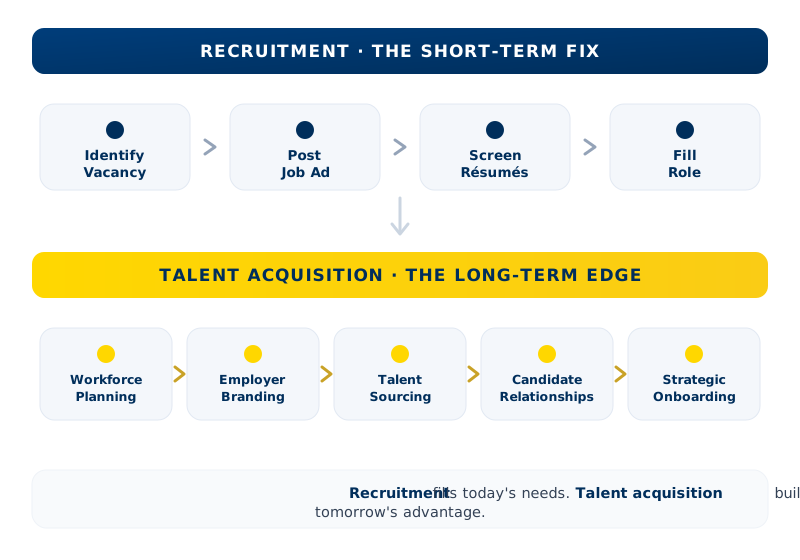
If your hiring process only begins when an employee hands in their resignation notice, you are operating in reactive mode. For a long time, traditional recruitment was purely transactional: a desk opened up, you posted a job ad, reviewed incoming resumes, hired someone, and repeated the process when the next vacancy appeared. But, while transactional recruitment fills immediate seats, it rarely builds a sustainable talent pipeline. That's where HR talent acquisition comes in.
HR talent acquisition takes a different approach. Instead of focusing only on filling today's opening, it looks ahead to tomorrow's workforce needs. It involves identifying future skill gaps, building relationships with high-potential candidates before roles become available, strengthening your employer brand, and creating a steady pipeline of qualified talent.
Why this matters: A reactive hiring process often forces managers to make rushed decisions just to get someone into the role. Those decisions can be costly. A widely cited CareerBuilder survey found that 74% of employers admitted they had hired the wrong person for a position. This highlights how common poor hiring decisions can be when organizations focus on filling vacancies rather than finding the right fit.
Talent acquisition also extends beyond making the hire. Bringing the right person into your organization is only part of the process; helping them succeed is just as important. Another frequently referenced industry benchmark from the Brandon Hall Group, found that organizations with a strong onboarding process improved new hire retention by 82%. Together, these findings reinforce the value of a long-term talent acquisition strategy that prioritizes thoughtful hiring, effective onboarding, and employee retention over simply filling open positions.
The Pillars of a Modern Talent Acquisition Strategy
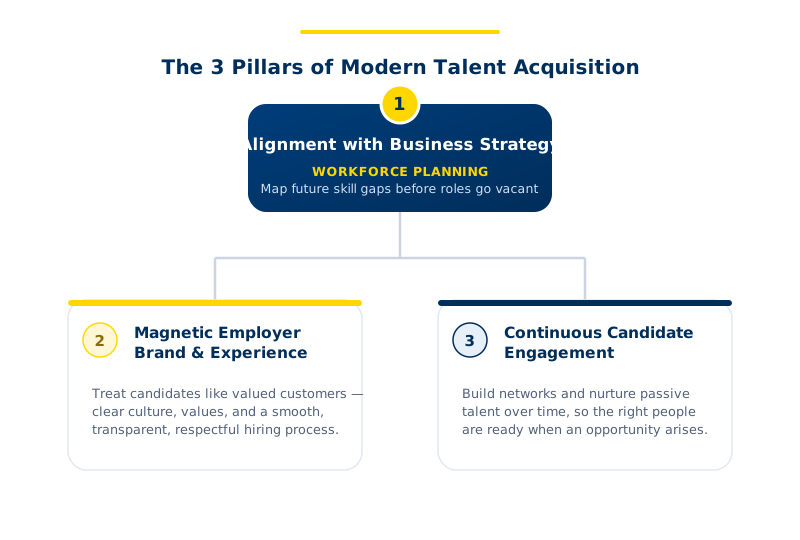
Building a proactive acquisition model requires moving beyond job boards. A mature talent acquisition framework relies on three strategic pillars:
1. Alignment with Business Strategy (Workforce Planning)
Before writing a single job description, HR leaders must ask: Where is the company going in the next 1 to 3 years, and what skills will we need to get there? Strategic talent acquisition uses workforce planning data to map out future skill gaps long before those roles become urgent vacancies.
2. A Magnetic Employer Brand & Candidate Experience
Top candidates evaluate your organization just as intensely as you evaluate them. Strategic acquisition treats job seekers like valued customers. This means clearly communicating your culture, values, and career growth potential, while ensuring the application and interview process is smooth, transparent, and respectful.
3. Continuous Candidate Engagement
Top-tier candidates are rarely actively job-hunting. Instead of waiting for them to apply, talent acquisition teams continuously build networks, nurture relationships with passive candidates, and maintain connection points over time so talent is ready when an opportunity arises.
Attributes to Consider When Seeking Top Talents
When interviewing prospective candidates, current skills and past performance only tell part of the story. To identify true high-potential employees, look beyond what candidates have already achieved and assess these three core talent attributes:
1. Adaptability & Learning Agility
Skills can become obsolete quickly as technology and markets evolve. Top talent stands out not by what they already know, but by how fast they learn.
Learning agility is the ability and willingness to learn from experience and apply those lessons to perform successfully under new or unfamiliar conditions.
Employees with high learning agility seek out feedback, experiment with new approaches, and pivot quickly when circumstances change.
2. Cultural Alignment & Leadership Potential
High potentials act as cultural anchors. They don't just conform to company values; they actively reinforce them through their daily actions and peer interactions.
Even before they hold formal management titles, high potential individuals display emergent leadership by influencing team morale, mentoring peers, and taking ownership during challenging projects.
3. Problem-Solving & Strategic Thinking
While average performers focus on immediate tasks, top talent naturally looks at the bigger picture. They understand how their work connects to overarching business objectives, anticipate potential bottlenecks, and approach challenges with a solutions-oriented mindset rather than just reporting obstacles up the chain.
When to Bring in a Talent Acquisition Consultant
Transforming an outdated recruiting model into an agile acquisition framework requires time, expertise, and infrastructure. This is where partnering with an external talent acquisition consultant creates immediate business value. A specialized consultant doesn't just help you fill roles; they audit and elevate your entire hiring structure by doing the following:
- Audit Existing Recruitment Processes: To identify bottlenecks causing high time-to-fill metrics or bad hires.
- Implement Modern Hiring Infrastructure: Recommend and set up the right recruiting software, candidate screening tools, and analytics systems.
- Redesign Interview & Assessment Workflows: Train hiring managers on structured, bias-free interviewing techniques.
Specialized talent acquisition consultants also help position your employer brand by articulating your company's unique value proposition to attract high-potential talent in competitive markets.
How to Attract and Retain Talented Employees
Hiring high-potential candidates is a major investment. Getting them to accept your offer is only the beginning. The real value comes from keeping them engaged long enough to grow with your business.
The challenge is that many organizations lose talented employees before they ever reach their full potential. According to Gallup, 52% of employees who voluntarily leave their jobs say their manager or organization could have done something to prevent them from leaving. This suggests that retention is often influenced by the employee experience rather than the employee's decision alone.
So, how do you keep your best people from becoming someone else's top hires? It starts with building a workplace where talented employees want to stay. Attracting top talent and retaining them should never be treated as two separate goals. The experience you promise during recruitment should match what employees find after they join your company. Here are three areas you should focus on. Tap each to expand.
Salary may convince someone to accept your offer, but it is rarely the only reason they stay. To retain high performers, you need a rewards package that reflects the value they bring.
Here are a few ways to do that:
- Keep your compensation competitive. Review salaries regularly to stay in line with your industry. You should also consider performance bonuses, profit sharing, equity, or other incentives that reward employees for helping your business grow.
- Invest in employee well-being. Health insurance, mental health support, wellness allowances, and generous leave policies show employees that you care about them beyond the work they produce.
- Give people flexibility where possible. Hybrid work, remote options, or flexible working hours give employees more control over how they work. That flexibility can reduce burnout and improve long-term retention.
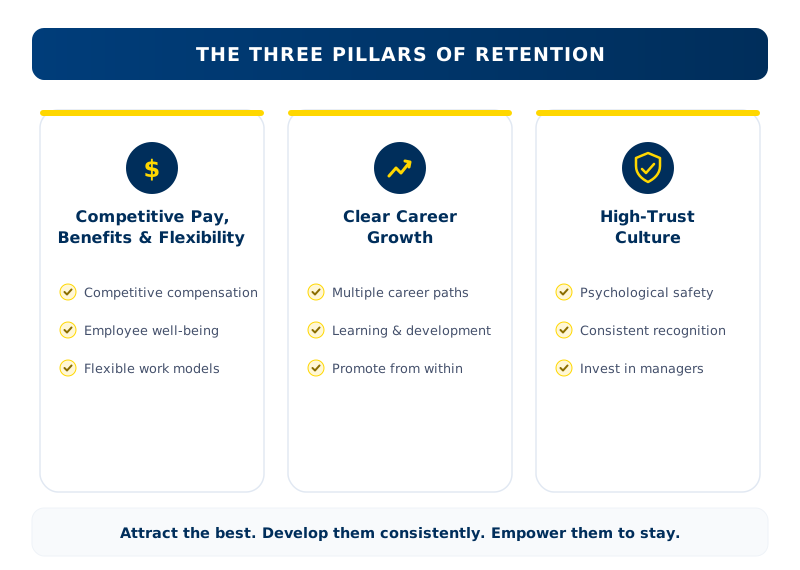
By focusing on these three pillars, you create more than a workplace that attracts talented people. You build an environment where they can grow, contribute, and choose to stay for the long term.
Conclusion
Building a resilient, high-performing team is a marathon, not a sprint. That's why moving away from reactive hiring and embracing a strategic talent lifecycle is the way to go. Your talent management strategy should be grounded in objective evaluation, proactive acquisition, and a culture of genuine retention. With this, you position your organization to not just fill seats, but to build a sustained competitive edge.
Remember, the true growth engine of your business isn't just the processes you implement, but the people you empower. Whether you are reassessing your current talent or refining your acquisition strategy, the commitment to nurturing your people today will define your ability to consistently hit business objectives over time.